
smithsonian institution arts and industries building
Washington, D.C.
Original Construction
1881
Completion Date
2001
Size
168,500 sqft
Cost
$180,000,000
The restoration and adaptive-reuse of the Smithsonian Arts and Industries building produced new spaces for galleries, education classrooms and labs, and visitor services, while the addition of a 40,000 square feet underground service wing includes a loading area, new mechanical systems, and administrative support spaces.
Built as the first building to house the National Museum—hence why it is in the heart of the Capital’s National Mall—the structure is nearly symmetrical in plan and elevation as it is organized in the form of a Greek Cross around a large central rotunda located at the intersection of the four major exhibit halls that divide the building into four equal quadrants. Each quadrant, originally open to the halls and the roof, contains the remains of a court and two ranges.
The Building Technology Studio of SmithGroupJJR, the precursor group to HopkinsBurns, performed a condition assessment of the building enclosure, a prerequisite for the execution of the historically significant museum’s multi-phased restoration. Leading the design team responsible for the repair and seismic upgrade of the mass masonry exterior walls, SmithGroupJJR completed a design for the restoration of these courts, which had been filled in with mechanical systems during the numerous renovations.
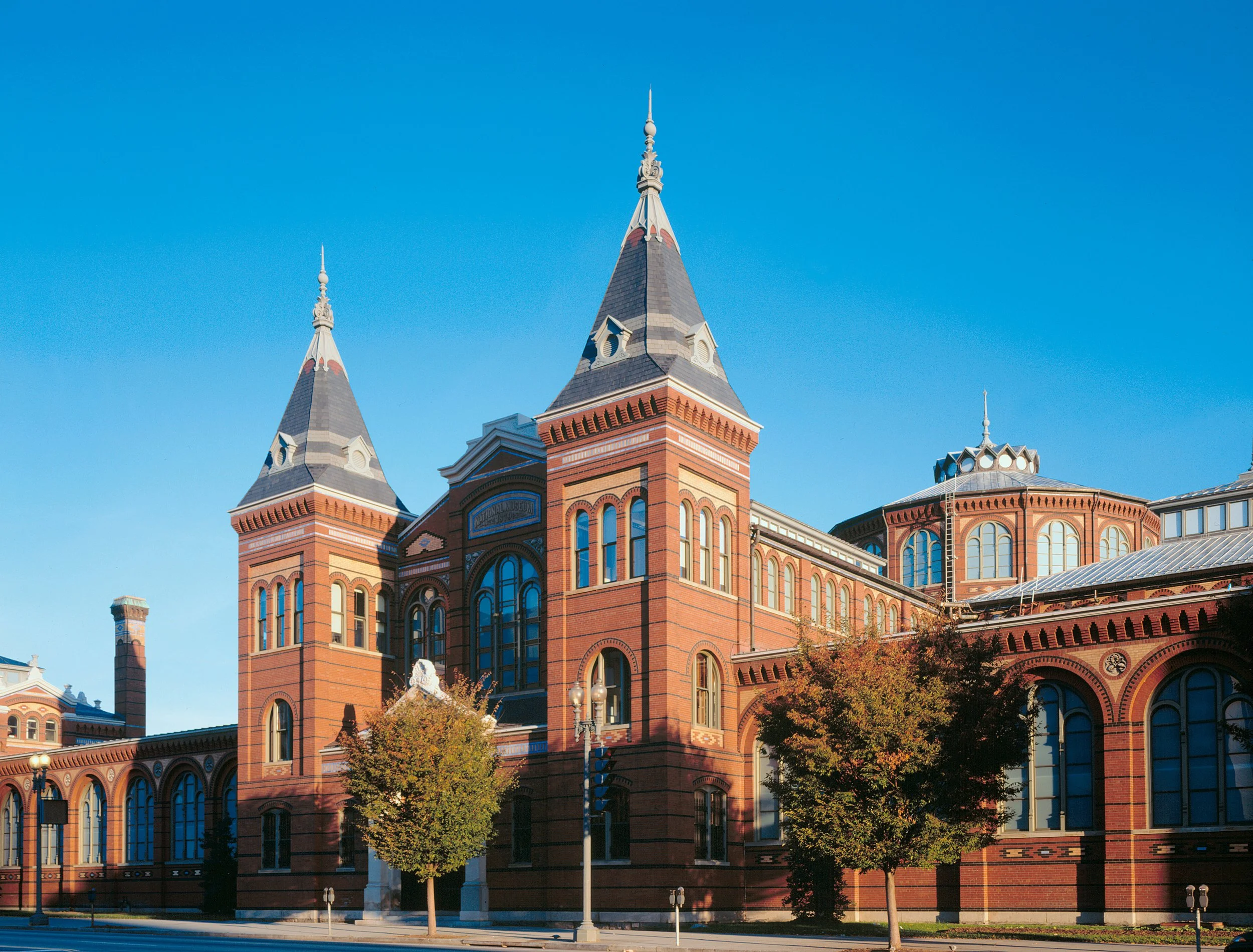
Each façade, oriented to a different cardinal compass point and reflecting the unique arrangement of the interior, is composed of articulated brick pilasters, in-fill brick walls, corbelled eaves, three-story pavilions at the corners, and three-story towers located at the center of each façade, flanking entrances to the four exhibit halls. Steep pyramidal roofs produce dramatic patterns atop the towers; as a prominent part of the building, the roof line reflects the maze of angles and slopes of the various roof types covering the halls, courts, ranges and rotunda.